By Alexandra Peeples Hunt

For years, I passed the Temple Beth-El Synagogue and Masonic Lodge #238 weekly, imagining what else they could become. A community arts center for the synagogue? Office space for Montgomery & Peeples in the lodge? As an architect, reimagining existing buildings is my life’s work, translating the spaces I see in my head into drawings on paper.
I know too intimately how much time and energy went into creating both structures, which is why it hurt to watch our community lose them within a few months of each other.
Buildings face demolition for many legitimate reasons: safety concerns, compromised foundations, hazardous materials, criminal activity, financial hardships, zoning compliance. Regardless of the cause, it always stings to watch them come down.
My historic preservation side wants to argue with the city or building owners to find a way to save these community artifacts. I want to remind them that Rome wasn’t built in a day, and that “The greenest building is the one already built” — a quote by architect Carl Elefante that I remember well from graduate school.
But rather than dwelling on losses, I choose to celebrate preservation victories.
Dalton has made significant efforts to preserve its past, with a major push from the late 1970s through the early 1990s to establish local historic districts and secure National Register listings. Preservation is often associated with outdated development ideas or stuffy house museums, but it offers so much more.
When an empty building is restored and brought back to life, it creates a layered story that forms bonds across generations; more shared memories, a stronger sense of community. I feel genuinely excited when I see a building reused rather than demolished. Sometimes, I’m even lucky enough to help launch a forgotten building into its next chapter.

The Depot: A Case Study in Preservation
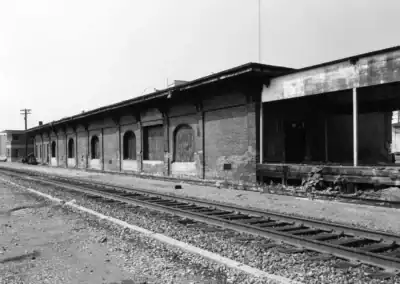
If you haven’t seen the new version of The Depot, stop by and experience it yourself. I was honored to be part of the team that guided its transformation from a dingy bar into a modern office and community meeting space. The revitalization started long before our firm, Montgomery and Peeples, joined the team in the summer of 2023 and continues today as the other half of the building undergoes renovation. Saving a building from the wrecking ball is often more about doing the right thing than the easy thing, which is exactly why this work deserves celebration.
The Depot hasn’t been a train depot in a long time. Growing up, it was the restaurant where I celebrated birthdays; later, the bar where I celebrated Fridays. It was an important downtown fixture for years before becoming an empty shell marked by graffiti and broken windows.
The revitalization process was messy. Improving rainwater and groundwater management alone took two months and far too many days in a crawlspace that no one should spend that much time in. The brick was soft in many areas and the mortar needed to be replaced. Floor joists spanned too far without proper support, making the floors wavy and turning the fancy new conference room doors into a real puzzle to install. Demolition revealed plenty of surprises about 1800s construction methods, a great reminder that I prefer being the designer over the contractor.


Celebrating the Details
We’re lucky to have places with such rich history in our community’s heart. I’m inspired by the architectural details that were preserved and highlighted throughout the process:
- Easton Ridley, the contractor, did incredible work reproducing massive exterior corbels that had gone missing.
- David Aft, President of the Community Foundation and building tenant, had the beautiful idea to install glass panels in doorways, revealing the multi-wythe structural brick construction from the 1800s.
- Liz Caperton, building owner, added a brass inlay to the bathroom vestibule tile showing when the building was originally constructed.
- The original wood floors were refinished, and the original large scale remains in place in the lobby.
We were honored to help bring The Depot’s new chapter to life. And luckily for Dalton, The Depot is not the only historic building that remains downtown.
Imagining new life for old spaces isn’t about freezing Dalton in time or turning our downtown into a museum. It’s about recognizing that these buildings are brick, mortar, and the physical embodiment of generations who lived in community here before us. When we preserve these structures, we honor that legacy. When we reimagine them, we make room for new memories, businesses, gathering places, and vision for future generations.
So the next time you pass an old building downtown, I invite you to do what I do: imagine what it could become.